
The Damage and Loss Model Library (DLML) is a curated, open, version-controlled library of damage and loss models for natural-hazard risk assessment of the built environment. It brings the component library from FEMA P-58, the building and infrastructure models from FEMA Hazus, and peer-reviewed models from the research community into one standardized, machine-readable format — spanning earthquake, hurricane, and flood, and covering individual building components as well as whole buildings and water, power, and transportation network assets.
Three commitments shape the library:
The DLML is the model source behind Pelicun, the SimCenter's damage-and-loss engine, and so underlies the analyses run in the PBE and R2D applications.
The library is meant to keep growing. If you have fragility or consequence models you would like to see included — your own, or ones you wish were easier to find — we would like to hear from you, and we are glad to add them to the library. We ask one thing of every model: a publication or report documenting it, so the library stays trustworthy. The SimCenter Wind Component Library shows what that looks like in practice.
Links:

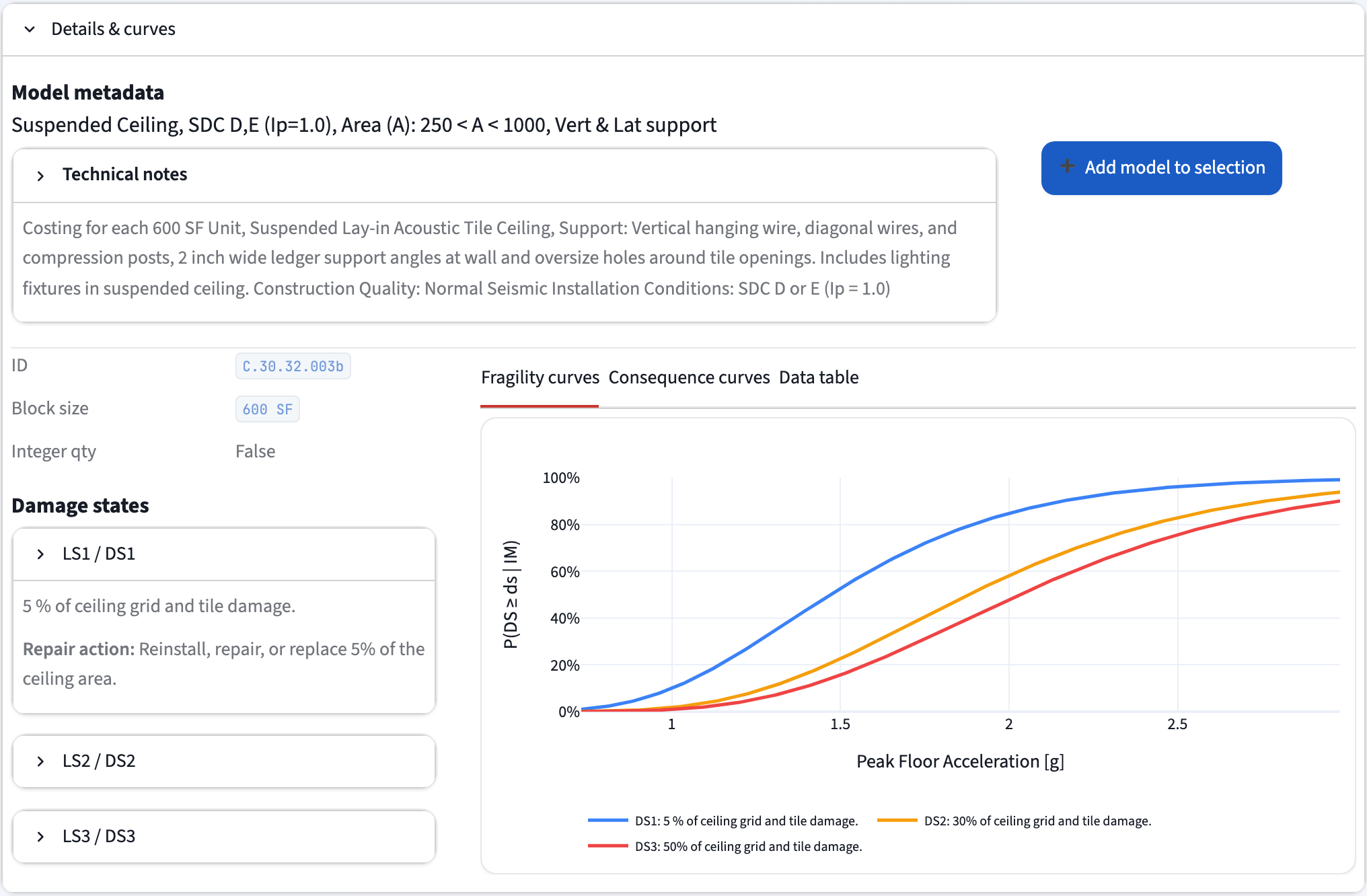
Each model’s information in one panel: technical notes, damage states, repair actions, fragility curves.
The DLML Explorer is the easiest way to discover the models. It is a web application — no account, no installation, nothing to configure.
With it you can:
If you would rather work with the data directly, the library is also a Python package: pip install simcenter-dlml gives you the full dataset plus an API for reading parameters, metadata, and schemas. The GitHub repository has the details, and you can run the Explorer on your own machine to browse your private, unpublished models alongside the public ones.
We gratefully acknowledge the generous in-kind contribution from Degenkolb Engineers, which supported the development work on the DLML Explorer. This material is based upon work supported by the U.S. National Science Foundation under Grants No. 1612843 and No. 2131111. Any opinions, findings, conclusions, or recommendations expressed in this material are those of the author(s) and do not necessarily reflect the views of the U.S. National Science Foundation or Degenkolb Engineers.

How to cite:
Vouvakis Manousakis, I. (2026). NHERI-SimCenter/DamageAndLossModelLibrary: v3.1. Zenodo. https://doi.org/10.5281/zenodo.7951657
Zsarnóczay, A., et al., (2025) An open-source simulation platform to support and foster research collaboration in natural hazards engineering. Front. Built Environ. 11:1590479. doi: 10.3389/fbuil.2025.1590479