Developed by the NHERI SimCenter with Degenkolb Engineers
The NHERI SimCenter has released the DLML Explorer, a web interface that streamlines access to information in the Damage and Loss Model Library. DLML Explorer enables engineers and researchers to search the library, review the parameters and metadata behind individual models, compare them side by side, and download a model dataset needed for a project — without working directly with the underlying data files.
Performance-based engineering depends on fragility and consequence models, but those models have never been easy to review. Furthermore, in addition to the body of existing component parameters from the FEMA P-58 second edition (2018), new damage and loss models continue to emerge from both research and practice. However, discovery is the first obstacle to sharing new models; a model that cannot be found is not, in practical terms, available. DLML Explorer provides access to a broad range of models and streamlines the process of data retrieval.
DLML Explorer is a view onto the Damage and Loss Model Library which is a curated, version-controlled collection that the SimCenter has developed and maintained since 2023. It gathers the FEMA P-58 component library, Hazus building and infrastructure models, and models from the research community into a single standardized format, with every model traceable to its source. The library is the default model source for Pelicun, and so it underlies the analyses run in the PBE and R2D applications. Version 3 of the DLML, released in July, also makes it directly installable as a Python package.
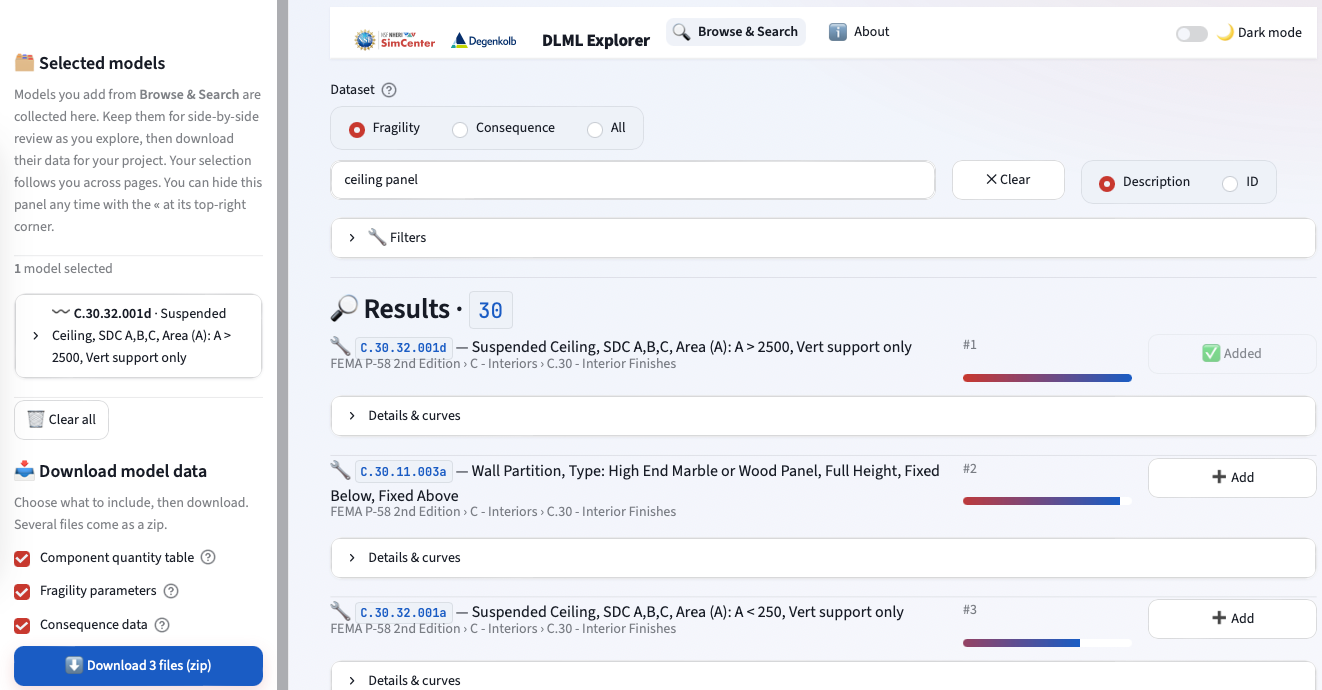
DLML’s Browse and Search page. Search in plain language, filter by hazard and source, and collect what you need.
In September 2024, engineers and researchers from the Applied Technology Council, AECOM, HBRisk, Magnusson Klemencic Associates, NIST, and Degenkolb Engineers discussed what a shared fragility library would need to be more useful to the community. SimCenter developed the DLML Explorer based on the takeaways from those discussions, with the help of Degenkolb, who supported the development work in kind. Tshajlij Lee, Hannah Thompson, Insung Kim, Robert Pekelnicky, and James Malley all contributed to creating the DLML Explorer. The SimCenter operates the DLML Explorer; Degenkolb supported its development but does not host or run it. The website and underlying database were presented at the 13th U.S. National Conference on Earthquake Engineering in Portland in July 2026.
Adam Zsarnoczay, SimCenter Associate Director of Research Outreach, notes that "the DLML Explorer gives engineers a single place to search for damage and loss models, along with their technical details and provenance. As the library grows with models contributed by researchers and practitioners, both groups of experts work from the same data, and ideas spread more easily across domains. This development opens up exciting new possibilities for advancing the simulation of damage, loss, and recovery from natural hazards."
The Explorer is at https://dlml-explorer.streamlit.app and needs no account. You can install the underlying library with pip install simcenter-dlml, which bundles the data and provides a Python API for reading model parameters, metadata and schemas; adding the [explorer] extra to the install command lets you run the web interface locally. Both are distributed under the BSD 3-Clause license, which means commercial use is supported. The DLML Explorer's “About” page covers the library and its governance in more detail.
The next step is contribution: making it straightforward for researchers and practitioners to add models, and ensuring that every model entering the library arrives with the documentation that makes it credible. The SimCenter Wind Component Library is an example of what that looks like — each of its models ships with the reference to the research behind it. If you have models you would like to see included, or thoughts on what would make the DLML Explorer more useful, join the discussion.
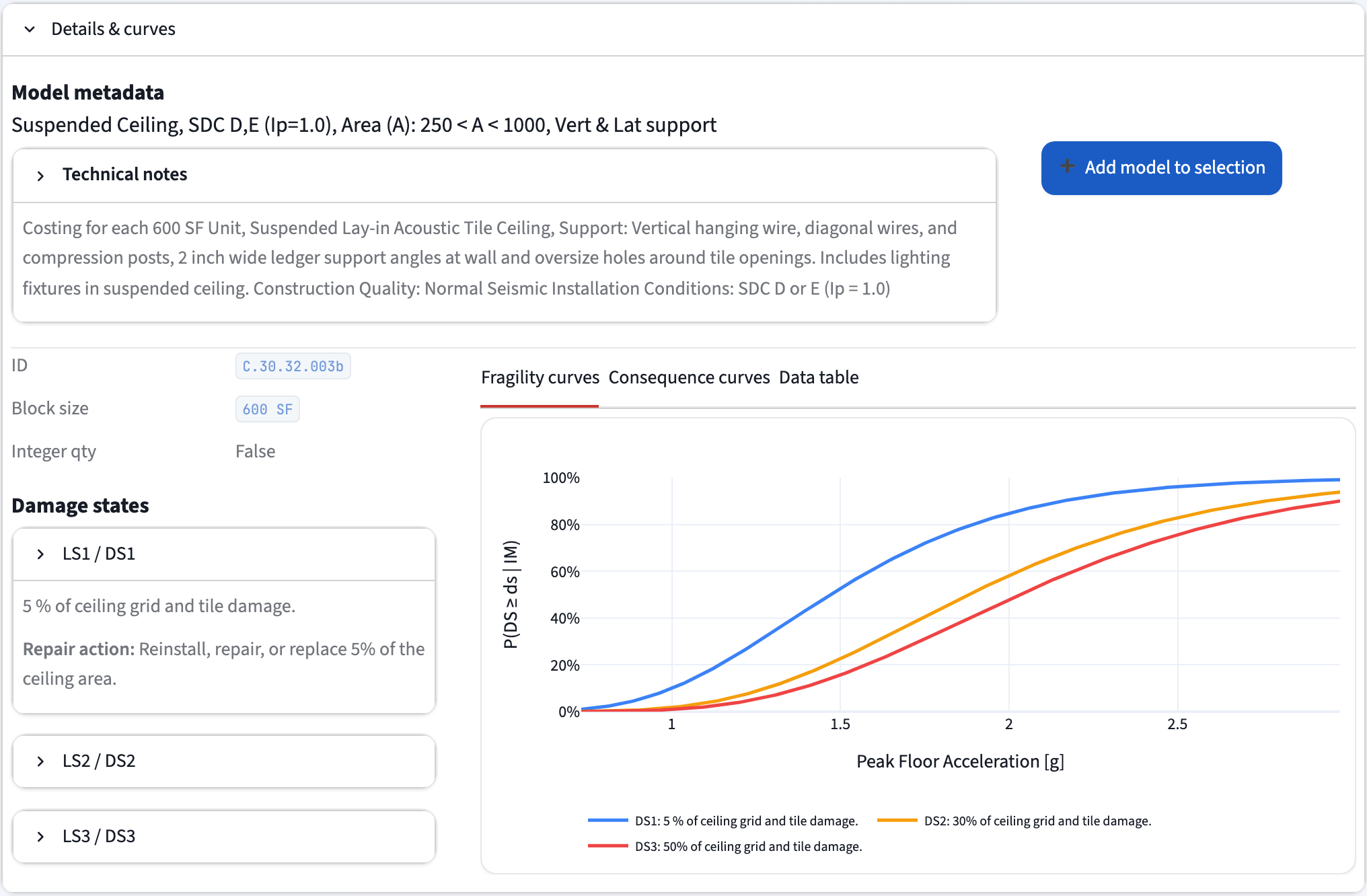
Each model’s information in one panel: technical notes, damage states, repair actions, fragility curves.
The DLML Explorer was developed by the NHERI SimCenter with a generous in-kind contribution from Degenkolb Engineers. This material is based upon work supported by the U.S. National Science Foundation under Grants No. 1612843 and No. 2131111. Any opinions, findings, conclusions, or recommendations expressed in this material are those of the authors and do not necessarily reflect the views of the U.S. National Science Foundation or Degenkolb Engineers.